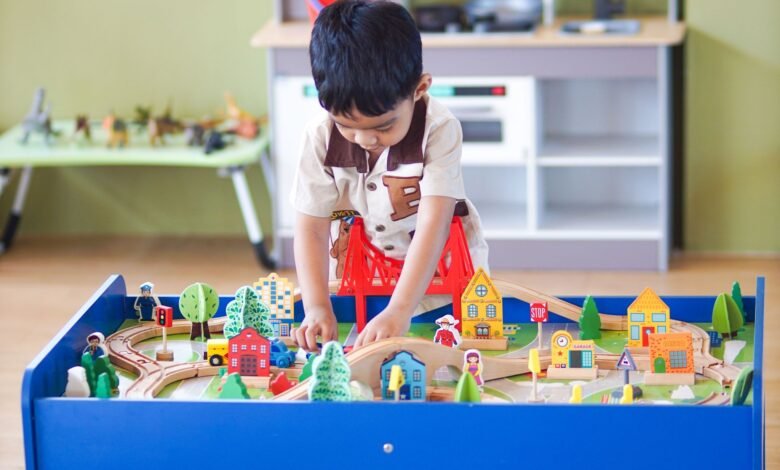
Parents comparing a nursery programme in Singapore usually want two answers: which age each class is for, and what children do in it. The Early Childhood Development Agency (ECDA) names the two nursery years Pre-Nursery, for children who turn three in the year they are enrolled, and Nursery, for children who turn four. Many centres call these Nursery 1 and Nursery 2. A nursery programme usually adds more structured activity to play, such as early writing, vocabulary and phonics, and a Mother Tongue Language. This guide sets out the ages and ratios, explains what a nursery curriculum includes, and covers how to compare nursery classes and schools with nursery near home.
What Ages Do Nursery 1 and Nursery 2 Cover in Singapore?
ECDA defines the two nursery years by the year a child turns three or four. Pre-Nursery, often called Nursery 1, is for children who turn three in the year they are enrolled. Nursery, often called Nursery 2, is for children who turn four. Class levels follow the calendar year, not the exact birthday.
| ECDA class level | Children who turn | Minimum staff-to-child ratio |
| Pre-Nursery (often called Nursery 1) | 3 in the year enrolled | 1 educator to 12 children |
| Nursery (often called Nursery 2) | 4 in the year enrolled | 1 educator to 15 children |
Because classes follow the calendar year, one Nursery 1 class can include a child born in January and another born in December, almost a year apart. The ratio also changes between the two years: each Nursery 2 educator is responsible for three more children than a Nursery 1 educator. Centres set their own class names and enrolment dates, so it is worth confirming which class a specific child would join.
That age spread is a reason to look at a child’s own progress rather than at classmates. Children in the same class level can differ in language, coordination and confidence, and a good nursery programme leaves room for that range by offering activities that more than one skill level can enjoy.
What Does a Nursery Programme Include?
A nursery programme builds on playgroup with more structured activity. Descriptions commonly mention hands-on and sensory activities, early writing and fine motor work, English vocabulary and phonics, and a Mother Tongue Language such as Mandarin.
My Little Campus’s nursery programme is one published example. It describes classes that stimulate young learners through the five senses, teachers who guide fine motor development through activities such as handwriting, and a bilingual approach covering English vocabulary and phonics alongside Mandarin recital and writing.
It helps to read these descriptions with a few questions in mind. How much of the day is guided activity, and how much is free play? How are English and Mandarin split? What does handwriting practice look like for a three-year-old, as opposed to a four-year-old? A programme that can answer these specifically is describing something real.
Learning Through the Senses and Play
For a child of three or four, a programme built on the senses means touching, building, drawing and asking questions, not sitting through lessons. Interdisciplinary activities, where one theme runs through stories, art, songs and play, let children explore a topic from several angles.
Early Writing and Fine Motor Skills
Fine motor control grows through drawing, colouring, cutting and moulding as well as writing, which is why a varied day matters as much as a handwriting activity. Progress at this age is gradual and uneven, and a steady improvement matters more than a particular grip.
English and Mother Tongue Language
Where a programme is bilingual, it helps to ask how often each language is used in a typical day. That gives a clearer picture than the description alone. It is also worth confirming which Mother Tongue Languages a centre teaches, as not every centre offers Malay or Tamil alongside Mandarin.
How Can Parents Compare Nursery Classes and Schools With Nursery Near Them?
Parents can compare nursery classes by asking the same questions at each centre: which ages the class serves, how many children are in it, what a typical day includes, and what changes between the two nursery years. Searches for schools with nursery near me are a starting filter. A visit settles the comparison.
Programme descriptions usually cover both nursery years together, so what changes in the second year is worth asking directly. It also helps to ask what happens for a child who is ready to move up early, or who needs a little longer at the current stage.
Staffing is another useful comparison. Asking a centre how many children and educators are in the specific class, in each nursery year, gives parents a more useful figure than the regulatory minimum.
On a visit, it helps to look at what children are doing rather than at what is on the walls. Parents can notice whether children are working with materials they can handle, how teachers respond when a child finds a task difficult, and whether the room has space for movement as well as seated activity. Those details show how the programme runs on an ordinary day.