The waste management industry is currently undergoing a quiet but violent shift. For decades, the barrier to entry was simply owning a truck and a few steel boxes. If you showed up on time and didn’t crush the customer’s driveway, you were in business. But as we move deeper into 2026, the “good ol’ boy” model of hauling is rapidly becoming extinct.
The market has matured. Customers—both residential homeowners and commercial contractors—have been trained by the likes of Uber and Amazon to expect radical transparency, instant communication, and seamless billing. The haulers who are adapting to this new digital baseline are scaling to seven figures with startling speed. The ones who aren’t are finding their phones ringing less and less.
It is no longer enough to just “work hard.” You have to work smart. The modern dumpster business is a data operation wrapped in heavy metal. Here are the top five operational standards that are currently separating the industry giants from the ghosts, and how leveraging the right tools can future-proof your fleet.
1. The End of the “Black Hole” Dispatch Board
In the old days, once a driver left the yard, they entered a black hole. Dispatchers relied on radio calls or text messages to know where the assets were. This operational blindness is now a critical liability. The new standard is total, real-time visibility.
Modern logistics platforms have replaced the static whiteboard with dynamic, map-based command centers. This isn’t just about tracking dots on a screen; it’s about “asset velocity.” Knowing exactly when a bin is dropped allows dispatch to immediately schedule the next move, turning a wasted hour into a billable haul. If your current system relies on a driver remembering to call you, you are already losing efficiency to a competitor who knows where their trucks are down to the second.
2. Your Website: The 24/7 Sales Dispatcher
There is a dangerous misconception that a website is just a digital business card. In reality, it is your most important employee. It never sleeps, never takes a lunch break, and can handle multiple customers at once. However, a generic website built by a cousin or a generalist agency won’t cut it anymore.
To compete today, you need professional dumpster rental website design that is engineered for conversion. This means having a site that understands the customer journey—guiding a homeowner through sizing options, capturing lead data instantly, and allowing for seamless online booking. If a contractor tries to book a swap at 10 PM and your site just says “Call Us,” you just lost that job to a company that lets them click “Book Now.”
3. The “Combat Simple” Driver Interface
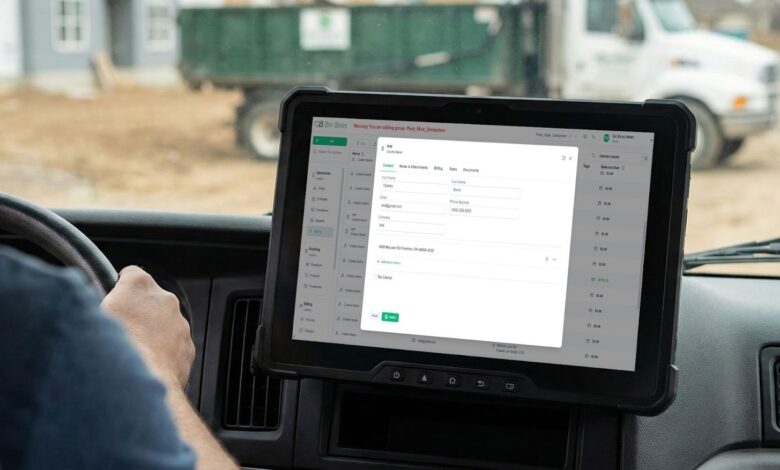
Technology in the office is useless if it fails in the cab. For years, software companies tried to force drivers to use complex, glitchy apps that required too much typing. Drivers, rightfully, rejected them. The new standard is “Combat Simple” usability.
The best tools today are designed for thick gloves and rainy job sites. They require zero typing. One tap to clock in. One tap to arrive. One tap to photograph the placement. By respecting the driver’s workflow and removing friction, you ensure 100% data compliance. This protects you from damage claims and ensures that the office always has the truth, straight from the field.
4. Automating the “Boring” Revenue
Profitability isn’t just about selling more dumpsters; it’s about plugging the leaks in your current bucket. The most successful companies today have automated the “boring” parts of the business: overage calculations and rental extensions.
Human dispatchers forget things. Software doesn’t. A modern platform tracks the exact weight of every load against the customer’s contract and automatically queues up overage charges the moment the scale ticket is entered. It tracks rental days with stopwatch precision, triggering daily fees the second a contract expires. This automated vigilance recovers thousands of dollars in “lost” revenue every month, adding pure profit to the bottom line without needing to find a single new customer.
5. Pricing That Aligns with Ambition
Finally, the industry is rejecting the outdated “per-user” software pricing model. This model, often called the “Success Tax,” penalizes growth by charging you more for every new dispatcher or driver you hire.
Leading platforms like Bin Boss Dumpster Software have pioneered a flat-rate model that supports scale. The philosophy is simple: technology should be an accelerator, not a toll booth. By locking in predictable operational costs, you are free to expand your fleet and your team aggressively, knowing your software bill won’t punish you for your ambition.
The Bottom Line
The era of managing a hauling business on gut feeling is over. The tools to professionalize, optimize, and scale your operation are here. The only question left is whether you will adopt them to build an empire, or stick to the old ways and watch the competition drive by.